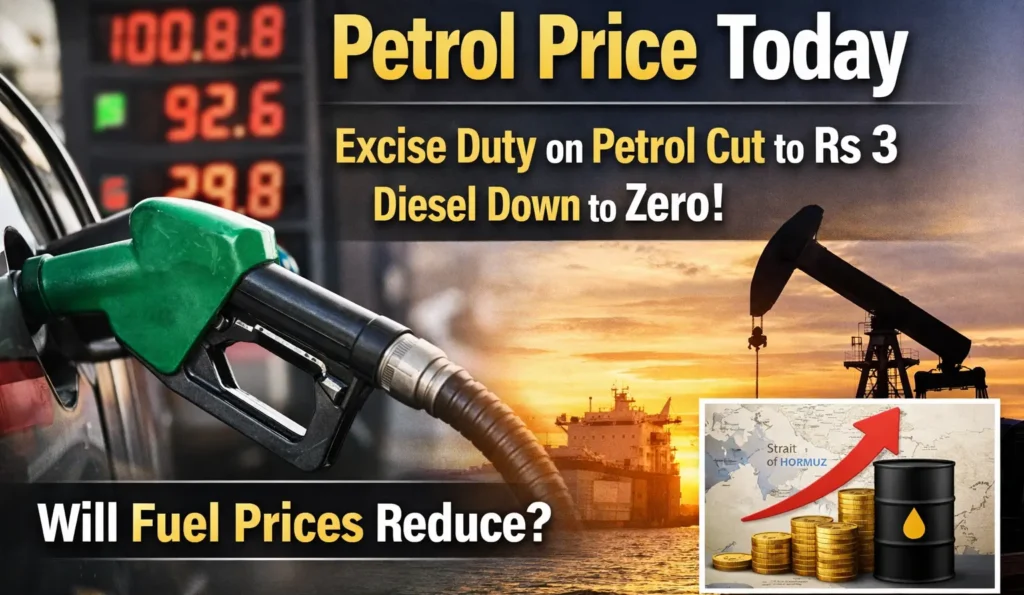

The topic of Petrol Price Today has once again taken center stage after the Indian government announced a significant reduction in excise duty on fuel. Amid rising global tensions and surging crude oil prices, this move has raised an important question among consumers. Will petrol and diesel prices actually decrease at fuel stations?

Let us break down the latest update and understand what it means for the common public.
Government Cuts Excise Duty on Petrol and Diesel
In a major decision, the Government of India has reduced excise duty on petrol and diesel by Rs 10 per litre each. This brings the central excise duty down to Rs 3 per litre on petrol and effectively zero on diesel.
The announcement was made in response to rising global crude oil prices triggered by the ongoing US-Israel war on Iranand disruptions in oil supply routes.
According to Hardeep Singh Puri, the government chose to absorb the financial burden instead of passing it entirely to consumers. This decision aims to protect Indian citizens from the volatility of international fuel markets.
Why Petrol Prices May Not Reduce Immediately
Despite the excise duty cut, experts believe that retail fuel prices may not see an immediate drop. The primary reason is the heavy losses currently faced by Oil Marketing Companies.
Reports indicate that OMCs are losing nearly Rs 48.8 per litre on fuel sales. This is largely due to the sharp increase in global crude oil prices, especially Brent Crude, which has crossed the 100 dollars per barrel mark and surged further in recent weeks.
International crude prices have gone through the roof in the last 1 month from around 70 dollars/barrel to around 122 dollars/barrel. Consequently, petrol and diesel prices for consumers have gone up all over the world. Prices have increased by around 30%-50% in South East Asian…
— Hardeep Singh Puri (@HardeepSPuri) March 27, 2026
As a result, the benefit of the excise duty cut is likely to be absorbed by these companies to offset their losses rather than being passed on to consumers.
Global Crisis Driving Fuel Price Surge
The ongoing geopolitical situation has had a major impact on oil supply chains. The conflict involving the United States, Israel and Iran has led to disruptions in the Strait of Hormuz, one of the most critical energy supply routes in the world.
This narrow passage handles nearly 20 to 25 million barrels of crude oil per day globally. For India, it is even more crucial, as around 40 to 50 percent of the country’s crude oil imports pass through this route.
Any disruption in this region directly affects fuel prices in India and across the globe.
Impact on India’s Fuel Economy
India heavily depends on imports for its energy needs. A significant portion of crude oil and liquefied natural gas comes from West Asia, including countries like Qatar and United Arab Emirates.
Due to rising international prices, fuel costs have increased worldwide. In some regions, prices have surged by up to 50 percent. However, the Indian government has tried to maintain stability by reducing taxes instead of increasing retail prices drastically.
What Consumers Can Expect Next
While the excise duty reduction is a positive step, it may not immediately reflect in lower petrol pump prices. The situation largely depends on global crude oil trends and geopolitical developments.
If international prices stabilize or decline, consumers in India may eventually benefit from lower fuel costs. Until then, the government’s move mainly acts as a cushion to prevent a sharper rise in prices.